
Posted 12/27/2025
Life is filled with odd incongruities. Here's one for you: though being a Christian myself, I flippin' love Vampire Weekend's music. I've always thought this was funny considering their third album, Modern Vampires of the City, contains the song "Unbelievers" which sounds like an unfettered dig at any kind of religion or higher beliefs. (Take a listen - even without the lyrics printed out in front of you, you'll hear what I mean.) Perhaps surprisingly, Christians have feelings too, and I wasn't too moved to listen to a song that I figured was against me or my beliefs. Moving forward in life, learning about different cultures and religions and becoming more confident in myself and my beliefs, I've only recently gone back and listened to the whole album front-to-back and it's pretty good. Probably still not my favorite album out of their discography, but I can appreciate it now.
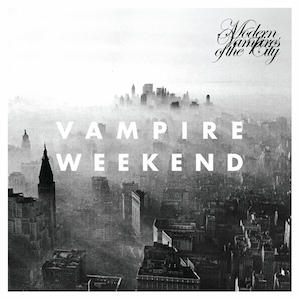
What's more interesting though, is after finally taking in the lyrics on Modern Vampires of the City, it felt like there was something more going on than just the band saying "religion bad." Their spiritually- or religiously-charged lyrics in this and albums following certainly never felt shallow. So I wanted to dig in a bit more.
To my surprise, there was an interview with the band where Ezra Koenig explicitly denied this poor reading of their lyrics. Have a block quote:
Ever since I first really got into the band after a friend said I should listen to Father of the Bride (thanks, T.!), one thing I've felt Vampire Weekend has consistently done well is capturing "the voice of the culture." Thankfully for my ego, I'm proven right by the above quote, because the pervading cultural feeling for people around my age has likley often been "unease."
Though the song Unbelievers is certainly well-done in a number of ways, from a recent listen of this album the song that's grabbed my attention was "Ya Hey." As for all Vampire Weekend songs, a search online will reveal tons of different interpretations of the lyrics of this song, but unfortunately a lot of them go back to the shallower "religion bad" interpretation. (I don't deny that some of that might be present if you pressed the songwriters on the matter, but I believe there is something more interesting than that here.) So I wanted to offer my two cents on this song, because I feel there's a lot more to it.
Verse 1:
After a pre-chorus and a chorus, verse 2:
One of the first things I noticed about the lyrics is that it seems the "you" changes throughout the song. In the first verse, "you" appears to be referring to a nebulous (un?)beloved while in the second verse, the singer could be seen as addressing God when he says "The faithless, they don't love you / The zealous hearts don't love you."
In this regard, it makes some parts of the song feel like a prayer. Wait, a prayer? Aren't prayers supposed to use "thee" and "thou" and heap praise upon God? Some prayers, sure, but the Bible is chock-full of prayers complaining to God. And not in stories about "here's how not to pray," but complaint-prayers come from some of the most pious figures of the Bible.
From King David, everyone's favorite flawed Bible hero:
Elijah, the great prophet:
And, uh... Jesus prayed like this too. FYI.
Okay, maybe the translation I used here (RSVCE) has some "thees" in it. But the point remains: the Christian tradition by no means bars people from speaking to God in all sorts of ways. With all this in mind though, have some more lyrics from Vampire Weekend:
Ooh, now that's a juicy prayer. It's not a new prayer though, because prayers like that were also prayed by people recorded in the Bible. Actually, it's not *just* a prayer in the Bible, it's an entire book - the book of Job.
(Quick, but relevant, aside - the book of Job is an absolute masterpiece of spirituality, but given that we're maybe 4000 years removed from the culture that gave it birth, consider reading a guide on it such as the book Wandering in Darkness by Eleonore Stump and you'll see what I mean. MAN that is a good book.)
At this point, people could easily diverge on lyrical interpretation - going with my theory that Vampire Weekend's lyrics are sometimes a bit deeper than people give them credit for, parts of Ya Hey could be read as a re-packaging of this complaint-prayer against God's hiddenness. Though people interpreting this in a more secular fashion still have some ammo given Ezra's quote up above, stating that this album encapsulates "millenial unease." Between Ya Hey and other songs on the album, the bigger picture is painted of a people that is unsure which way to head - the phrase "I don't want to live like this / But I don't want to die" has now appeared on TWO of their albums! If there was a catchphrase for an entire generation or three of people, I think it would be that. Absolutely genius songwriting.
I don't think anyone should be TOO sure about a "more religious" or a "more secular" parsing of the intent behind these lyrics, though. Another tidbit to keep in mind is that Ezra of Vampire Weekend is pretty up-front about his Jewish background.
Though his way of phrasing this may have changed over the years, I just want to share this formulation of his Jewish background from a 2006 blog post he made about the philosophy behind his fashion choices (man this guy is cool - no, I am not saying that facetiously):
Ezra, if you're reading this and don't look back fondly on your 2006-blogging days, I am sorry for digging this up again. But that's hilarious.

Ezra Koenig's live reaction to reading this post
Now let me play the part of Captain Obvious: all of this is to say, that this feels like a distinctively Jewish song, funnily enough. A devout American Christian would have to strain to write a song like this. At least from my perspective, this song summarizes the average American-culturally-Jewish's perspective on God and whatnot. Sorry to employ this phrase, but if you know, you know. Perhaps I can leave it at: from my outsider's perspective, this American-culturally-Jewish experience sounds like the regular "millenial unease" but with more historical, cultural, social and religious baggage. (And I use the term "American-culturally-Jewish" more in juxtaposition to, say, Orthodox Jews.)
(And to walk on eggshells another time, if Vampire Weekend means what I think they mean when they sing about "...spinning 'Israelites' / Into '19th Nervous Breakdown...'" hoo boy. Now I'm REALLY not gonna touch that. I guess listen to those songs & lyrics and draw your own conclusions about what Ya Hey might be saying lol.)
Given Christianity's roots in Judaism though, I can confirm that Christians can vibe not only with the tune of Ya Hey, but largely with the lyrics also (heck, see Jesus' complaint-prayer above!). Unfortunately, your local fundamentalist-Christian radio station will not be playing this because any kind of negativity is HARAM to them or something. (Haram... now I'm getting REALLY inclusive.)
The Jewish roots of this song go deeper when the lyrics mention "Through the fire and through the flames." I think most people will take this as a reference to any kind of suffering, but I figured they might be referring specifically to Jewish persecution through the ages, given the reference to the song 'Israelites' elsewhere in Ya Hey in tandem with Ezra's Jewish background. Though regarding the fire and the flames, one of my first thoughts was actually the story of the three young men in the furnace (see Daniel 3). Maybe I'm reaching on this one, but I find it potentially interesting that fire was chosen to represent suffering if Daniel 3 can be read into this song. Some innocent Jews do indeed suffer in Daniel 3, but the story ends with a fourth figure being found in the furnace and the other three miraculously surviving being thrown into a blazing-hot furnace. Christians pretty much across the board read this as a foreshadowing of Jesus taking human flesh since the fourth figure in Daniel 3 is seen as godly/angelic/heavenly. So if Vampire Weekend did have Daniel 3 in mind writing that line, that's very, very interesting. (Of course, a reference to Daniel 3 works from a Jewish perspective too since they could simply see the fourth figure as a type of appearance of God or an angel.)
"But jojo2k," I hear you say, "God being or feeling hidden is one of the biggest proofs against practicing religion or spirituality."
And to that I say, let me leave it to some people wiser than I:
And again:
And yet again:
To phrase it another way: religious people have certainly not seen it that way. See everything from Job to Jesus - we don't control God and he works in his own ways. He is outside of time and space and his thoughts are far above our thoughts. In the times when we don't understand his actions, we groan, we pray... and sometimes we sing songs like Ya Hey.

GRRR that's such a good way to end talking about this song but there's still so much more that could be said. Again, I mostly mention all this because it's very possible that there is more to this song (and a lot of their songs that mention religion/spirituality/etc.) than "religion bad."
Another part about this song I really enjoy. The first verse reminds the first "you" (perhaps in this context, it could be seen as "you," the listener!) that the "big movers" from Zion to Babylon to America "don't love you." Then in the second verse, the singer reminds GOD that both the extreme ends of thought from the "faithless" to the "zealous hearts" don't love God. I feel like the singer could be implying a kind of kinship here - the rich fat cats reject the average person on the street and tons of people reject God - so humanity and God find themselves both as outcasts. This works from a Jewish or Christian perspective too, actually! God, rejected either by the Israelites (see, like, most of Exodus and Numbers) or through the person of Jesus (rejected by the people of his day, crucified); Jews rejected by society (see, like, most of history) or Christians rejected by society (have you tried telling someone you're Catholic in the United States?!).
This song can also be in some ways heart-wrenching and hopeful from the Christian perspective also. Hopeful when considering "Through the fire and through the flames" in a Christian reading of Daniel 3 as above - that Jesus will personally come and save those who cry out to him. But heart-wrenching when considering that from certain culturally-Jewish perspectives, there's not really a happy ending. From some such perspectives, either the stories about God are made up and no one's coming into the furnace to save us or the stories ARE true and God has basically abandoned his people (think ongoing Jewish persecutions). Same goes for the part immediately following: "You won't even say your name / Only 'I am that I am' / But who could ever live that way?" Surely this lyric intends to complain to God that he is hidden and uncaring, but even from the traditional-Jewish sense this seems half-right when considering something like Deuteronomy 4:7 ("For what great nation is there that has a god so near to it as the Lord our God is to us, whenever we call upon him?"). And then the Christian hearing this can only feel bad for our Jewish brothers and sisters because we believe that God DID fulfill all those promises to come down and be with us in the person of Jesus. For those hoping for a name more personal than the Tetragrammaton, we have it: Jesus.
I feel it should go without saying, but please have mercy on me for I paint in broad strokes with little nuance. I could expand every paragraph here with an additional 10 sentences of nuance and disclaimers, but know I'm just a little guy gushing about the genius behind this lyric crafting. Even if everything I said above was wrong, I think we can all still appreciate Vampire Weekend's works as vignettes of a crazy, confused, mixed-up world.
And this little analysis doesn't even cover all the lyrics of this song... people can (and have!) craft like four different "theories" or stories behind every Vampire Weekend song just by putting emphasis on specific lines from a given song... man Vampire Weekend is so cool.
Anyways, thanks for reading! If you have any other thoughts on this song or anything feel free to connect in the JOJO2K COMMUNAL UNIVERSE. Love y'all~
Click here to go back to the main Works page.